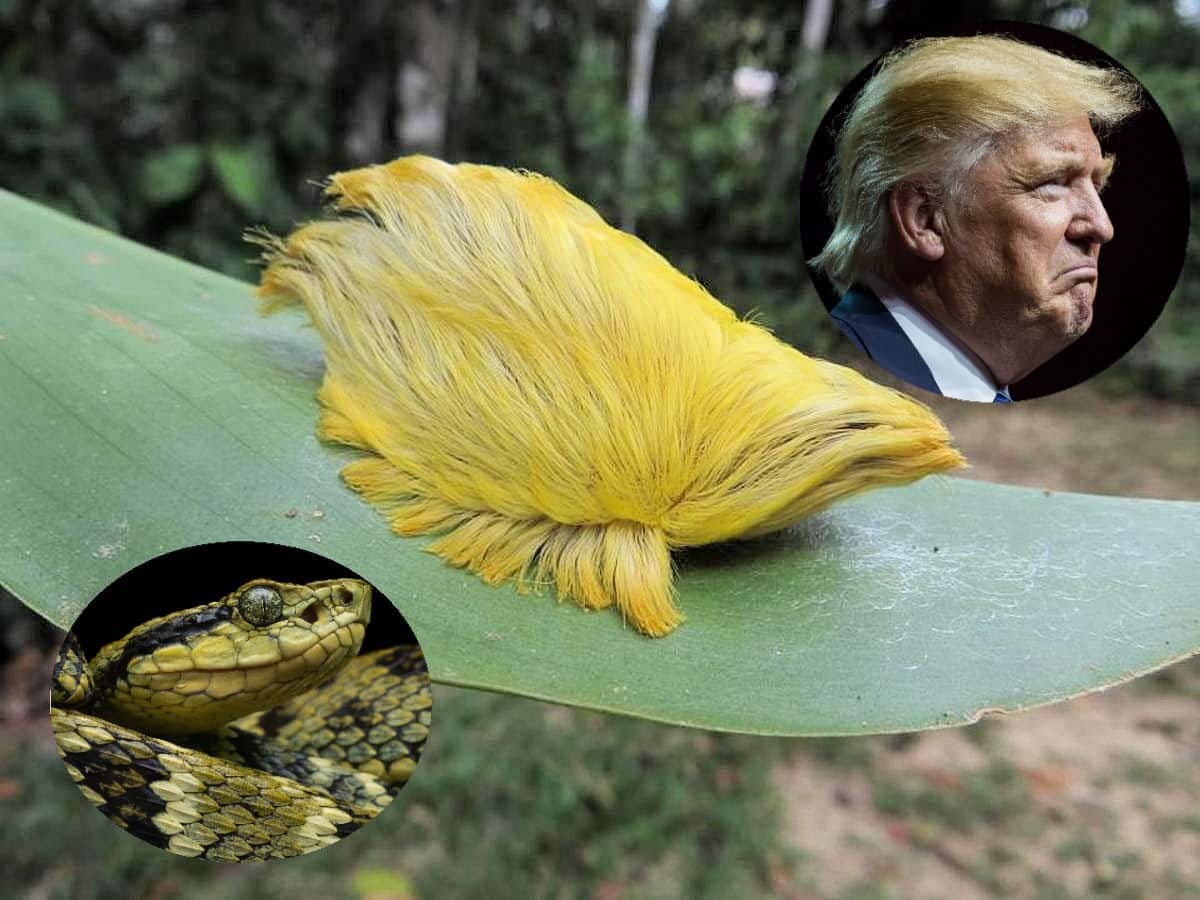
Which is deadlier to humans in Peru: the Bothrops pit viper or the venomous Trumpapillar?
By Rick Vecchio ✐
Peruvian Times Contributing Editor*
Applying Trumpian logic, pit vipers cause more than six times as many human fatalities in Peru as stings by the “Trumpapillar,” a nickname for the venomous flannel moth caterpillar (family Megalopygidae, often Megalopyge opercularis) found in Peru’s Amazon.
In other words, about six people die in Peru from snakebites every year — give or take — and there is no record of anyone ever dying from the Trumpapillar’s venomous, toupée-like spines.
During a Christmas address Sunday from the White House, the 79-year-old Trump went on a nearly 10-minute tangent, misrepresenting the memoir Venom and Valor by Dr. James J. Jones, who wrote about being bitten in 2016 by a poisonous snake in the Amazon.
Trump Claims 28,000 Die Yearly from Peru Snakebites — The Real Number Is About Six
“Twenty-eight thousand people die a year from a snake bite, a certain snake,” President Trump falsely claimed. “It’s a viper, right? It’s said to be the most poisonous snake in the world.”
Trump rambled on: “The chances of living from that snake are substantially less than 1 percent and that’s only if you have the [anti]venom. Even if you have the [anti]venom you don’t live.”
To set the record straight: Snakebites in Peru do occur, but the incidences and resulting death toll is nowhere close to tens of thousands.
Using health-service notifications compiled across the Americas, one peer-reviewed analysis estimated that about 2,150 snakebites per year in Peru were treated in health facilities during 2000–2015, resulting in about 10 deaths per year on average (i.e., fatalities typically in the low double digits).
Actual Snakebite Deaths in Peru: Single Digits to Low Double Digits
The same research cautions that case counts can be underestimated when victims rely on traditional care and never enter the reporting system, but even allowing for undercounting, Peru’s deaths remain “low double digits,” not “thousands.”
A Peru report by Infobae, citing Peru’s epidemiology center (MINSA/CDC) gives a similar order of magnitude in real time: 1,355 ‘envenomation’ cases and six deaths reported through early August 2023 (partial-year), again pointing to fatalities measured in single digits to low double digits.
As for treatment: antivenom is effective when it’s the right product, given early, and in an adequate dose — and it’s the core, specific therapy for venomous snakebites.
Trump’s False Claims About Antivenom Effectiveness
According to the World Health Organization, antivenoms remain the only specific treatment that can prevent or reverse most venom effects when administered appropriately and early. Most deaths and serious consequences from snakes bites are avoided in Peru because antivenoms are effective, as well as widely available.
Jones, now one of President Trump’s physicians assigned to the White House medical evaluation and treatment unit, was attached to the Secret Service protective detail that accompanied Malia Obama during her 2016 gap-year travel through Peru and Bolivia.
Dr. James Jones’ Real Snakebite Story: Protecting Malia Obama in Peru
The Peru trip, part of an 83-day program run by Where There Be Dragons, was kept secret until after the group returned to the United States, according to the Amazon Conservation Association, which hosted Malia Obama at its Villa Carmen biological station in Peru.
A 2017 Army Times report, citing Department of Defense news coverage, also connected Jones’ Peru detail to a New York Times report that Malia Obama took an 83-day hiking trip in South America.
Where There Be Dragons describes its Peru-Bolivia program as rugged travel across the Andes and the Amazon, with homestays and trekking that include Lake Titicaca, Machu Picchu, and the Sacred Valley.
Local operator, Vamos Expeditions, later said it supported the Peru logistics for the Dragons group and worked alongside 15 Secret Service agents and support vehicles, while the students traveled through Cusco, the Sacred Valley, Machu Picchu, and on high-altitude hikes near Ausangate, followed by time in the Amazon.
Jones Saved Lives Before Fer-de-Lance Snake Attack
Jones’ role on the ground was not symbolic.
On Sept. 26, 2016, while hiking at about 18,000 feet in Peru’s Andes, he assessed a Secret Service agent who had fluid in his lungs from altitude exposure and organized an improvised evacuation: He used a pack mule for transport, gave oxygen and anti-inflammatory medication, and then coordinated a four-hour drive to a hospital in Cusco, according to the U.S. Department of Defense.
A week later, on Oct. 4, Jones treated two of the American students on the hike for malnutrition and the same acute altitude sickness, camping with them overnight and arranging pack-mule transport back to base.
After reaching base, he identified worsening symptoms in one student — fluid on the brain — and pushed for emergency transport to Cusco. His citation also noted that word spread through nearby communities that a clinician was present, and indigenous residents began arriving at base camp for care.
How Dr. James Jones Survived a Fer-de-Lance Bite in the Amazon
On Oct. 9 — five days after treating the students — Jones became the patient.
During a hike near Pilcopata, in the remote outskirts of the Amazon basin, he was bitten by the snake. He fell into a dense ravine, tried to continue, then collapsed about 1.5 miles into the trail with severe symptoms, including trouble breathing and escalating pain in his arm.
Jones later wrote on his personal blog that he had slipped in mud and landed on a fer-de-lance, and that the evacuation stretched for miles in the field before he reached emergency care.
Never touch Donald Trump’s Hair
As for the infamous “Donald Trump Caterpillar,” locals and experts advise never touching them. They look soft, harmless and oddly photogenic, but those urticating hairs deliver painful venom via tiny spines, causing welts and burning irritation lasting days.
_______________________________
✐ Rick Vecchio is also director of marketing and development for Fertur Peru Travel, which is owned by his wife, Siduith Ferrer, and is a commercial sponsor of Andean Air Mail & PERUVIAN TIMES. You can read more of his articles on the Peruvian Travel Trends blog.