By Poppy Tollemache ✐
Peruvian Times Contributing Writer

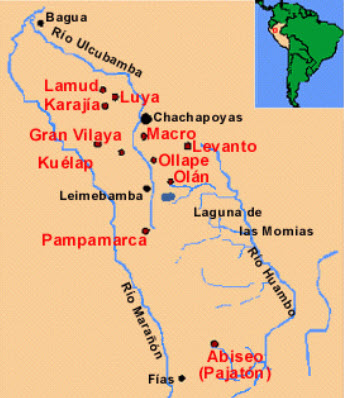
Archaeologists have uncovered more than 100 new structures at Gran Pajatén, a site linked to the Chachapoyas people, situated on a ridge overlooking the valley of the Montecristo River, 500 kilometres north of Lima. First discovered in the 1960s, little has been known about this pre-Inca civilisation due to the inaccessible nature of its settlements high in the dense, mist-covered cloud forests of northern Peru. These new findings mark a significant step toward uncovering more about the Chachapoyas and understanding the complexity and significance of the Gran Pajaten site.
Led by the World Monuments Fund (WMF) in Peru between 2022 and 2024, a multi-disciplinary team used cutting-edge technology such as LiDAR scanning, photogrammetry, topographic mapping, and technomorphological analysis to uncover the structures, without disturbing the fragile ecology in the Gran Pajatén complex. As a result, the WMF have managed to produce the most detailed map of the site to date, revealing a sprawling network of circular stone structures far exceeding the 26 buildings first documented in the 1960s.
“This discovery radically expands our understanding of Gran Pajatén and raises new questions about the site’s role in the Chachapoya world,” said Juan Pablo de la Puente, executive director of WMF Peru. “Evidence now confirms that it is not an isolated complex but part of an articulated network of pre-Hispanic settlements from different periods.”
“What makes this moment so meaningful is not only the scale of what’s been uncovered, but how we were able to do it,” said Bénédicte de Montlaur, president and CEO of the World Monuments Fund. “These technologies allow us to peel back the layers of history without causing harm, preserving both knowledge and nature.”
The site was explored in the 1960s by American explorer Gene Savoy, by Peruvian archaeologist Federico Kauffman Doig, and even by the Peruvian military, who carved out a helicopter landing site. In the 1980s, an archaeological team led by Warren Church from the University of Colorado extensively explored the area, which by then had become part of the Rio Abiseo National Park.
Who were the Chachapoyas?
Existing between 800 and 1500 CE, the Chachapoyas were known as the “people of the clouds” because of their habitations in the high-altitude cloud forests. The inaccessibility of their mountain strongholds, combined with their warrior tactics, allowed them to resist Inca conquest longer than most, until just before the arrival of the Spanish in 1524 CE. And, until now, they have also resisted excavation and thorough archaeological investigation.
The most impressive surviving example of Chachapoya civilisation is Kuelap, a large urban, political, and religious complex that sits 3,000 metres above the Utcubamba River valley. Kuelap, which can now be accessed by cable car, predates Machu Picchu by at least 700 years. Its ceremonial structures are decorated with impressive stone mosaics and anthropomorphic figures, complex stonework that rivals the craftsmanship of the Incas, making it one of the most remarkable archaeological sites in the Andes.
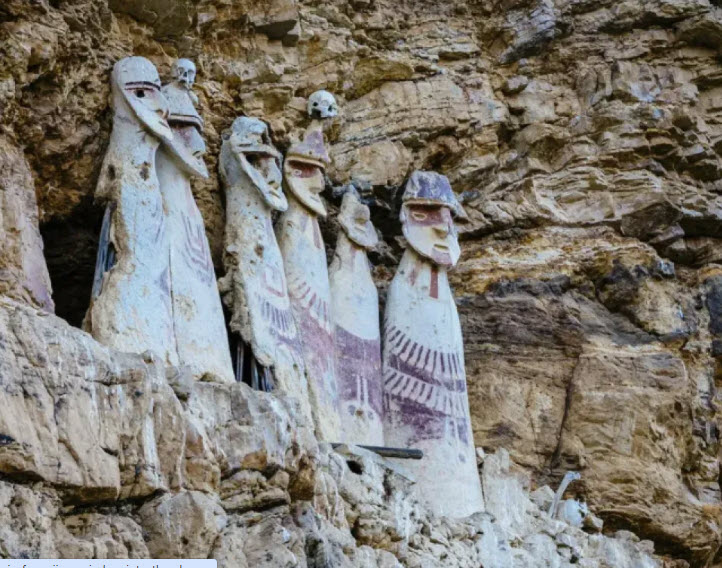
The Chachapoyas are also known for their impressive cliff tombs, such as the striking sarcophagi of Carajia, also located in the Utcubamba Valley. Perched perilously on a sheer cliff face, the sarcophagi are human-shaped and tall, each up to 2.5 meters high. Their vertiginous position is believed to be a deterrent to looters, as well as a way of preserving the dead in eternal watch over the valley. Carajia has been recognised as part of the UNESCO-listed cultural heritage of the region.
Nearly 300 kilometres south from Kuelap sits Gran Pajaten. It was thought to be a small, isolated ceremonial centre. Until now.
What is the significance of this discovery?
The scale and complexity of the newly mapped site, as well as the discovery of a vast road system linking Gran Pajaten with other major sites in the region such as La Playa, Papayas, and Los Pinchudos, is proof of a sophisticated and interconnected cultural landscape.
“These findings suggest that Gran Pajaten was not a solitary ceremonial centre but part of a far-reaching settlement network, offering new insights into the scale and organisation of the Chachapoya civilisation,” said Juan Pablo de la Puente.
The WMF’s findings not only elevate Gran Pajaten’s importance within the Chachapoya’s elusive heritage, but also offer a new template for archaeological exploration in ecologically sensitive regions.
“The clarity and scope of these discoveries—particularly in such challenging terrain—exceeded expectations and opened exciting new avenues for further research,” adds Pablo de la Puente.
The WMF have launched a virtual tour of Gran Pajatén and Río Abiseo, allowing global audiences to explore the site without having to disturb its fragile ecosystem.
Moving forward, this approach of merging advanced technology, environmental care, and archaeological investigation offers a promising model for showcasing and safeguarding other remote and ecologically sensitive heritage sites worldwide. More definitive reports on the significance of Gran Pajaten are expected later this year, thanks to the findings made possible by WMF’s advanced technology.