A smart, 138-page guide to Peru’s history, culture and living Andean traditions.
By Rick Vecchio ✐
Peruvian Times Contributing Editor*☄
When I opened Peru: The Cultural Gem of South America, I had the Almost Famous moment — when Ben Fong-Torres realizes the seasoned rock and roll writer on the other end of the line is actually a teenager.
I’d edited Paarth Mathur’s work earlier this year and assumed he was a graduate student.
“Peru: The Cultural Gem of South America: Culture, Medicine, Language,” by Paarth Mathur (2025)
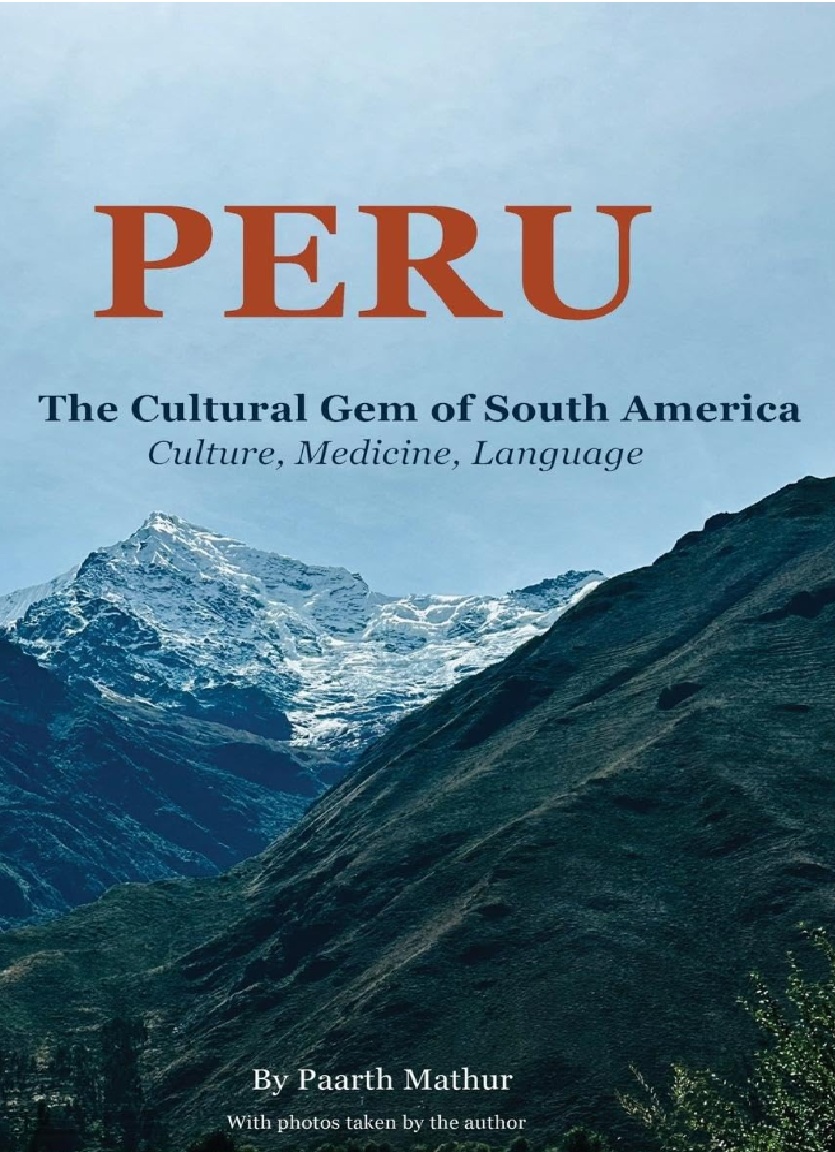 This is not a scholarly monograph. It’s a clear, compact and engaging travel book, written by a high school junior.
And surprise! I would readily recommend Mathur’s book to travelers and curious readers who want a fresh, informed overview of Peru’s history and living culture. Pack this compact 138-page hardcover alongside your Lonely Planet. While the guidebook will tell you where to eat, Mathur tells you why that meal matters.
What makes it work is Mathur’s curiosity. He covers the expected ground, like Inca engineering, Spanish colonization and Machu Picchu, but he doesn’t stop at brochure copy. In the chapter on traditional medicine, you learn not just that Peruvians drink eucalyptus tea, but why: the compounds, the preparation, the beliefs around healing.
His discussion of Quechua preservation links neatly to Alberto Flores Galindo’s idea of the “Andean utopia,” showing how language carries a worldview of reciprocity, balance and relationship with the earth.
The section on Inca trepanation (ancient skull surgery with striking survival rates) is an especially good read, undercutting the notion that advanced medicine sprang only from the West. His treatment of coca moves past drug-war clichés to its nutritional and medicinal role in the Andes.
Now and then Mathur slides into youthful earnestness (“This is not just a preface to a book. It is an invitation”), but the sincerity is disarming.
After a somewhat boilerplate 15-page first chapter, Mathur takes off, writing with the excitement of someone discovering things in real time. He is also careful about his position as an outsider writing about Indigenous culture, and he says so.
Not every chapter has the same charge. The sections on Peruvian cities and globalization feel more dutiful than driven, as if he knew they belonged in the book but didn’t love writing them. Still, those are minor lapses in a work that delivers more substance than you would expect from 138 pages. By contrast, the very next section on Peruvian sports is unexpectedly strong, packed with historical details I never knew.
Mathur discusses buen vivir (sumak kawsay in Quechua) not just to provide a definition, but to show what it does. He explains it literally as ‘living well,’ then sets it against Western, growth-first development models. What matters to him is that this isn’t a nostalgic idea. It is a working Andean ethic that weighs prosperity alongside reciprocity, community obligation and care for the land. He makes clear that many Peruvians still treat it as a viable path to alternative economic development.
Heady stuff from such a young writer in a topsy-turvy world.
Bottom line: Mathur wants that world to know that in Peru, ancient wisdom need not be abandoned for modernity. During his travels, Mathur saw that Peru’s way of preserving cultural identity while still innovating offers a lesson how to tackle today’s environmental and social challenges.
That’s the real point: the achievement isn’t that a high school student wrote this, but that he wrote something useful. This is a very quick read that you want to take along during your trip to Peru — the one that helps you understand how Indigenous cultures hold on in a globalized world.
Age aside, the book stands on its own: clear, informed, genuinely illuminating.
_______________________________
✐ Rick Vecchio is also director of marketing and development for Fertur Peru Travel, which is owned by his wife, Siduith Ferrer, and is a commercial sponsor of Andean Air Mail & PERUVIAN TIMES. You can read more of his articles on the Peruvian Travel Trends blog.